John Adams You Say That You Would Like to Go Over Life Again 1825
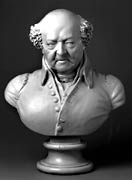
John Adams (October 30, 1735 – July 4, 1826) was a pol and the 2d President of the United States. The close friendship between Thomas Jefferson and John Adams began when they met at the 1775 Continental Congress in Philadelphia. Although different in many ways down to their advent, the two developed a strong respect and liking for ane another. In 1776, they worked together on the committee to draft the Annunciation of Independence, and in 1784, Jefferson joined Adams in France on diplomatic service. While Jefferson remained in Paris, Adams served primarily in London, from where, Jefferson wrote Abigail Adams, he considered her "as my neighbor."1 In March of 1786, Jefferson went to England on diplomatic business, though in the two months he was there, he and Adams institute fourth dimension to make a bout of English gardens. They also visited Shakespeare'southward home — and chipped off a bit of his chair as a souvenir, in Adams's words, "according to the custom."two
Through their work and play, Jefferson and the Adamses became close friends. Jefferson revealed his affection to James Madison, writing that Adams "is so amiable, that I pronounce you will love him if ever you become acquainted with him."3 Mrs. Adams one time called Jefferson "1 of the choice ones of the world,"4 and Mr. Adams wrote Jefferson that "intimate Correspondence with you lot ... is ane of the most agreable Events in my Life."v
Despite their close friendship, Jefferson wrote that he and Adams were often separated by "dissimilar conclusions we had fatigued from our political reading."6 The two maintained their friendship despite their political differences until 1801, the year that Jefferson became president. As Jefferson wrote Mrs. Adams: "I can say with truth that one human action of mr Adams's life, and one just, ever gave me a moment'due south personal displeasure."7 By this, Jefferson was referring to last-minute political appointments made by Adams but before Jefferson succeeded him as president. Jefferson wrote that the appointments "were [selected] from among my nearly ardent political enemies" who could exist counted on to work against his executive authority. Jefferson admitted to "brooding over information technology for some fiddling fourth dimension," and during this period, they ceased writing one another.8
 When Jefferson retired from the presidency in 1809, Dr. Benjamin Rush, a signer of the Proclamation that Adams and Jefferson worked to create, took it upon himself to renew their suspended friendship. He had no success until 1811, when one of Jefferson's neighbors visited Adams in Massachusetts. The neighbour returned to Virginia with the report that he had heard Adams say, "I always loved Jefferson, and withal love him." In response to these words, Jefferson wrote Dr. Rush: "this is enough for me. I only needed this knolege to revive towards him all the affections of the almost cordial moments of our lives."9 He asked Rush to persuade Adams to renew their correspondence. A letter from Adams was forthcoming, and they connected to write until their deaths.
This reconciliation began a rich correspondence that touched on myriad topics, from reminiscences virtually their contributions to the young nation'southward history, to opinions on current political issues, to matters of philosophy and religion, to bug of aging. Their letters were also lighthearted and filled with affection. Jefferson wrote to Abigail Adams, "I have compared notes with mr Adams on the score of progeny, and find I am ahead of him, and call back I am in a fair style to keep so. I accept 10½ grandchildren, and 2¾ groovy-m-children; and these fractions will ere long become units."10
Afterwards 15 years of resumed friendship, on July four, 1826, Jefferson and Adams died inside hours of each other. Their deaths occurred — possibly accordingly — on the fiftieth anniversary of the signing of the Annunciation of Independence. Unaware that his friend had died hours earlier, Adams'due south family later recalled that his last spoken words were, "Thomas Jefferson survives."xi
The written words of Jefferson and Adams, nevertheless, survive to this twenty-four hour period, preserving the rich legacy of their friendship, thoughts, and ideas. In their later years, Jefferson responded to a reflective question from Adams: "You ask if I would agree to alive my lxx. or rather 73. years over again? To which I say Yea. I retrieve with yous that information technology is a good world on the whole, that it has been framed on a principle of benevolence .... I steer my bark with Hope in the head, leaving Fear astern."12
Jefferson on Adams
1783 Feb 14. (Jefferson to Madison). "His vanity is a lineament in his graphic symbol which had entirely escaped me. His desire of taste I had observed. Nonetheless all this he has a sound head on substantial points, and I retrieve he has integrity."thirteen
1787 January thirty. (Jefferson to Madison). "He is vain, irritable and a bad calculator of the forcefulness and likely effect of the motives which govern men. This is all the sick which can possibly be said of him. He is as disinterested as the being which made him: he is profound in his views: and accurate in his judgment except where noesis of the world is necessary to grade a judgment. He is so amiable, that I pronounce you will dearest him if ever y'all go acquainted with him."14
1804 June 4. (Jefferson to John Wayles Eppes). "He and myself have gone through so many scenes together, that all his qualities have been proved to me, and I know him to possess and then many skillful ones, as that I have never withdrawn my esteem ...."fifteen
1807 June 12. (Jefferson to William Short). "I have heard indeed that my predecessor sometimes decided things confronting his council by dashing & trampling his wig on the floor. this but proves what you & I knew, that he had a ameliorate eye than caput "16
1811 Jan xvi. (Jefferson to Rush). "Mr Adams was honest as a pol as well equally a man .... I accept the aforementioned good opinion of mr Adams which I ever had. I know him to be an honest man, an able one with his pen, and he was a powerful advocate on the floor of Congress."17
1823 August 30. (Jefferson to Madison). "[T]his still I will say for mr Adams, that he supported the annunciation with zeal & ability, fighting fearlessly for every word of it."18
Further Sources
- Cappon, Lester J., ed. The Adams-Jefferson Messages: The Complete Correspondence Betwixt Thomas Jefferson and Abigail and John Adams. Chapel Loma: Academy of North Carolina Press, 1959. This work collects all the known messages between Abigail and John Adams and Jefferson; a one-book paperback edition was published in 1988.
- Library of Congress. "John Adams: A Resources Guide." A listing of books and websites virtually John Adams compiled by staff at the Library of Congress.
- Massachusetts Historical Society. "Adams Family Resources." A listing of important Adams family sources, both online and in print.
- McCullough, David Grand. John Adams. New York: Simon & Schuster, 2001.
- Peterson, Merrill D. Adams and Jefferson: A Revolutionary Dialogue. Oxford: Oxford University Press, 1978.
- Wait for further sources on Adams and Jefferson in the Thomas Jefferson Portal.
Source: https://www.monticello.org/site/research-and-collections/john-adams
0 Response to "John Adams You Say That You Would Like to Go Over Life Again 1825"
Post a Comment