No Difference Between Veal and Beef
 by Victoria Mazmanyan | Last updated on April 18, 2021
Education: General Medicine at YSMU

vs

Summary
Beef is higher in calories, protein, and fats; however, veal has a more favorable protein and fat quality. Beef is lower in cholesterol.
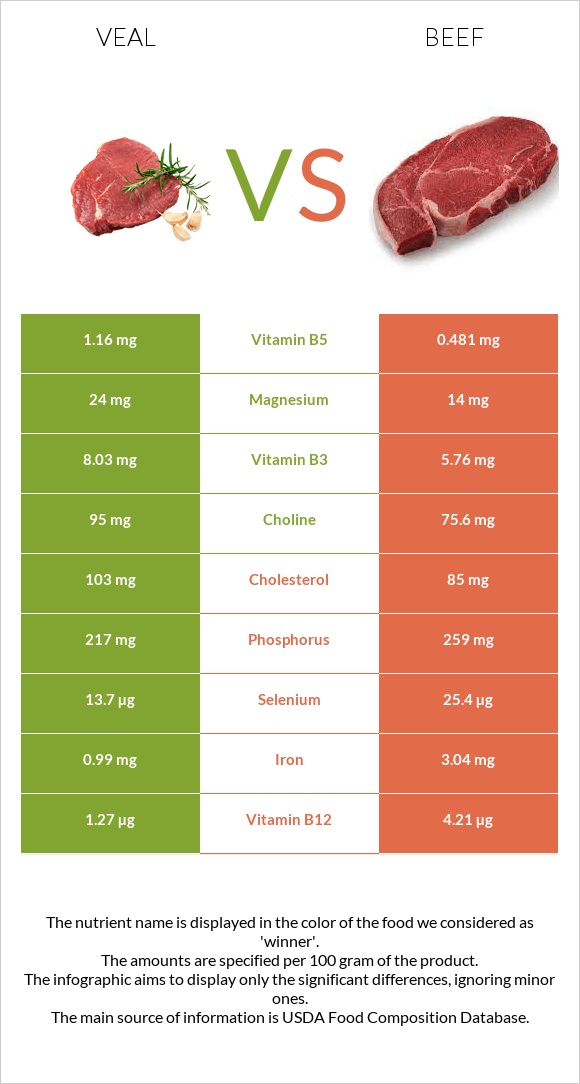
Veal is richer in most B group vitamins except for vitamin B12, which can be found in larger amounts in beef. Beef is also higher in iron and zinc.
The adverse effects of red meat are attributed to the high levels of saturated fats, cholesterol, and heme iron. Veal, being lower in all of these, can be assumed to be the healthier choice.
Table of contents
- Introduction
- Classification
- Appearance
- Taste and Use
- Price
- Varieties
- Nutrition
- Macronutrients and Calories
- Calories
- Fats and Cholesterol
- Protein and Carbohydrates
- Vitamins
- Minerals
- Glycemic Index
- Acidity
- Weight Loss & Diets
- Health Impact
- Health Benefits
- Cardiovascular Health
- Diabetes
- Downsides and Risks
- Cardiovascular Health
- Diabetes
- Cancer
- References
Introduction
Humans have been consuming the meat of cattle from prehistoric times. Cattle were domesticated in around 8500 BC, mainly due to the multitude of valuable products they could provide humans.
Today, bovine meat is among the most consumed meats in the world. This article will look at the two main types of bovine meats - veal and beef - comparing their nutritional values and health impacts to see which meat is the better choice.
Classification
Veal is the meat of calves: young domestic cows or bulls. Beef, on the other hand, is produced from older cattle.
Both veal and beef can be produced from either sex of the cattle. However, veal is commonly cut from the meat of young males of dairy cows, while most beef comes from young heifers and steers. Heifers are immature females, and steers are young castrated males.
Beef and veal are classified as red meats due to the high levels of myoglobin and, therefore, the iron bound with it.
Appearance
While veal and beef are both red meats, beef is significantly darker in color. Because of its high myoglobin content, beef is also higher in iron.
Taste and Use
Veal, notably, has a more tender texture and a more delicate taste. Veal is also easier to digest when compared to beef.
Cattle meat is very versatile and is used in staple dishes from numerous cultures. Veal and beef can be cooked by grilling, barbecuing, broiling, roasting, frying, and many other ways.
Price
According to the general market value of meats, beef is slightly cheaper.
Varieties
Based on the cut of the meat, both veal and beef can be called the chuck (shoulder), the brisket and shank (breast), the rib, the sirloin (hip), the short loin, the short plate, the flake, and the round. These different cuts have varying culinary characteristics and are used according to those qualities.
Based on the conditions in which the cows have been kept, veal can be formula-fed, also known as milk-fed or white, non-formula fed, also known as red, pasture-raised, or free-raised, and bob veal. Bob veal is the meat of the calf, slaughtered at less than one-month-old.
Beef can also be grass-fed or organic.
Nutrition
The nutritional values below are presented for broiled ground veal and broiled patty beef, consisting 85% of lean meat and 15% of fat.
Macronutrients and Calories
Beef is overall denser in nutrients, as it consists of only 58% water, whereas veal contains 67% water.
Calories
Both of these meats are high-calorie foods; however, beef is significantly higher in calories. One hundred grams of beef contains 250 calories, while the same amount of veal has 172 calories.
Fats and Cholesterol
Beef contains almost twice the amount of fats found in veal.
The fat content of beef and veal is similar. Nevertheless, veal is slightly higher in polyunsaturated fatty acids, while beef contains more monounsaturated and saturated fats.
Veal is higher in cholesterol.
Protein and Carbohydrates
Beef is a little richer in protein; however, veal contains a significantly higher amount of all essential amino acids. Therefore, the quality of protein from veal is more favorable.
Like most meats, beef and veal contain no notable amount of carbohydrates.
Vitamins
Overall, veal is richer in most vitamins, providing more vitamins B1, B2, B3, B5, and folate or vitamin B9. Veal is also higher in vitamin E.
At the same time, beef contains vitamin A, which veal lacks completely. Beef also provides over twice the amount of vitamin B12 compared to veal.
Beef and veal contain similar amounts of vitamin B6 and vitamin K.
Both of these meats are absent in vitamin C and vitamin D.
Vitamin Comparison
Vitamin comparison score is based on the number of vitamins by which one or the other food is richer. The "coverage" chart below show how much of the daily needs can be covered by 300 grams of the food
7
:
2
Contains more Vitamin E +25%
Contains more Vitamin B1 +52.2%
Contains more Vitamin B2 +53.4%
Contains more Vitamin B3 +49.3%
Contains more Vitamin B5 +76.3%
Contains more Folate +22.2%
Contains more Vitamin A +∞%
Contains more Vitamin B12 +107.9%
Equal in Vitamin B6 - 0.382
Equal in Vitamin K - 1.2
Contains more Vitamin E +25%
Contains more Vitamin B1 +52.2%
Contains more Vitamin B2 +53.4%
Contains more Vitamin B3 +49.3%
Contains more Vitamin B5 +76.3%
Contains more Folate +22.2%
Contains more Vitamin A +∞%
Contains more Vitamin B12 +107.9%
Equal in Vitamin B6 - 0.382
Equal in Vitamin K - 1.2
Minerals
Veal and beef are packed in minerals in different amounts.
Beef is significantly higher in iron, zinc, and selenium when compared to veal. Beef is also a little lower in sodium.
Veal, on the other hand, contains larger amounts of magnesium, copper, manganese, phosphorus, and choline.
Veal and beef contain nearly the same levels of calcium and potassium.
Mineral Comparison
Mineral comparison score is based on the number of minerals by which one or the other food is richer. The "coverage" chart below show how much of the daily needs can be covered by 300 grams of the food
4
:
4
Contains more Magnesium +14.3%
Contains more Copper +21.2%
Contains more Iron +162.6%
Contains less Sodium -13.3%
Contains more Zinc +63%
Equal in Calcium - 18
Equal in Phosphorus - 198
Equal in Potassium - 318
Contains more Magnesium +14.3%
Contains more Copper +21.2%
Contains more Iron +162.6%
Contains less Sodium -13.3%
Contains more Zinc +63%
Equal in Calcium - 18
Equal in Phosphorus - 198
Equal in Potassium - 318
Glycemic Index
As beef and veal both do not contain carbohydrates, their glycemic index is considered to be 0. You can read more about the glycemic index of foods with no carbohydrates here.
Acidity
The acidity of meat is higher immediately after the slaughter and starts to steadily fall while the meat ages.
The acceptable range of the pH value for beef falls between 5.3 to 5.7, making beef acidic (1). Once the pH value of beef reaches 6.5, it starts to decompose.
The pH values for veal are similarly acidic, ranging from 5.5 to 6.1, depending on the level of maturity (2).
The potential renal acid load values for veal and beef are 12.1 and 12.6, respectively. The PRAL value demonstrates how much acid or base the given food produces inside the body - the higher this positive number, the more acid-producing the food.
Weight Loss & Diets
Most meats, including beef and veal, are high in calories. Beef contains 78 more calories per every hundred-gram serving compared to veal.
Between these two types of meats, veal is the better choice for low-calorie and low-fat diets. They both fit well into low carb and low glycemic index diets.
Various studies have concluded that meat intake, especially processed meats, leads to an increased risk of weight gain and obesity prevalence (3, 4, 5).
Contrastingly, another study suggested that high-protein, low-fat diets can be effective in decreasing weight, with both a rich or restricted intake of lean beef as red meat (6).
In weight loss diets, lean, unprocessed meats are advised to be chosen over fatty and processed meats (7).
Health Impact
Now that we have looked at the nutritional differences between beef and veal, we will look at the effects of these two types of meats on health.
Health Benefits
Cardiovascular Health
Low in saturated fats, lean beef can have a favorable effect on cardiovascular disease lipid risk factors, decreasing total cholesterol and low-density lipoprotein levels (8). Veal is also lower in saturated fatty acids, being lower in fats.
One study has shown that a healthy diet high in protein, with or without red meat, may improve cardiometabolic disease risk factors (7).
Diabetes
A diet low in calories and high in protein from lean red meats has been studied to improve risk markers of type 2 diabetes mellitus (9).
Downsides and Risks
Cardiovascular Health
Despite the previous findings, research has shown that consumption of unprocessed but especially processed red meat leads to a small increased risk of cardiovascular disease and all-cause mortality (10). Substitution of protein from soy, nuts, and legumes instead of red meat has been associated with a lower risk of cardiovascular disease (11).
These adverse effects are said to be caused by a chemical found in the blood after eating red meat, called trimethylamine N-oxide or TMAO (12)
Diabetes
Similarly, unprocessed and particularly processed red meat has been correlated with a higher risk of diabetes. This risk may be partly due to the contents of heme iron and dietary cholesterol found in red meat (13). As veal is lower in both heme iron and dietary cholesterol, it can be assumed that veal is the better choice between these two kinds of meat for people with prediabetes or diabetic conditions.
Cancer
Consumption of red meats, in particular processed red meat, has long been associated with an increased risk of several types of cancer.
Total red meat intake increases the risk of colorectal, nasopharynx, lung, pancreas, breast, and prostate cancer (14, 15, 16).
In addition, processed red meat also elevates the risk of squamous cell carcinoma of the esophagus and non-cardia stomach cancer (14).
References
- The effect of pH on beef eating quality
- https://www.researchgate.net/publication/283006713
- https://www.ncbi.nlm.nih.gov/pmc/articles/PMC2697260/
- https://bmcnutr.biomedcentral.com/articles/10.1186/s40795-016-0063-9
- https://www.researchgate.net/publication/5501979
- https://www.ncbi.nlm.nih.gov/pmc/articles/PMC5598025/
- https://academic.oup.com/ajcn/article/108/1/33/5036105
- https://www.ncbi.nlm.nih.gov/pmc/articles/PMC3238465/
- https://pubmed.ncbi.nlm.nih.gov/31771921/
- https://jamanetwork.com/journals/jamainternalmedicine/fullarticle/2759737
- https://www.bmj.com/content/371/bmj.m4141
- Eating red meat daily triples heart disease-related chemical
- https://www.ncbi.nlm.nih.gov/pmc/articles/PMC3483430/
- https://www.wcrf.org/dietandcancer/exposures/meat-fish-dairy
- https://pubmed.ncbi.nlm.nih.gov/31389007/
- https://www.ncbi.nlm.nih.gov/pmc/articles/PMC6171413/

Education: General Medicine at YSMU
Last updated: April 18, 2021
Infographic
Which food is preferable for your diet?

is better in case of low diet
| | | |
| Low Fats diet | | |
| Low Carbs diet | Equal | |
| Low Calories diet | | |
| Low glycemic index diet | Equal | |
People also compare
Vitamin and Mineral Summary Scores
The summary score is calculated by summing up the daily values contained in 300 grams of the product. Obviously the more the food fulfills human daily needs, the more the summary score is.
Vitamin Summary Score
47
52
Mineral Summary Score
42
55
Macronutrients Comparison
Macronutrient comparison charts compare the amount of protein, total fats, and total carbohydrates in 300 grams of the food. The displayed values show how much of the daily needs can be covered by 300 grams of food.
Protein
146%
156%
Carbohydrates
0%
0%
Fats
35%
71%
Comparison summary
Which food is lower in Saturated Fat?
Veal is lower in Saturated Fat (difference - 2.855g)
Which food is richer in vitamins?
Veal is relatively richer in vitamins
Which food contains less Sodium?
Beef contains less Sodium (difference - 11mg)
Which food is lower in Cholesterol?
Beef is lower in Cholesterol (difference - 15mg)
Which food is cheaper?
Beef is cheaper (difference - $0.2)
Which food contains less Sugar?
?
The foods are relatively equal in Sugar (0 g)
Which food is lower in glycemic index?
?
The foods have equal glycemic indexes (0)
Which food is richer in minerals?
?
It cannot be stated which food is richer in vitamins. See the charts below for detailed information. See the charts below for detailed information. See the charts below for detailed information.
Source: https://foodstruct.com/compare/veal-vs-beef
0 Response to "No Difference Between Veal and Beef"
Post a Comment